From “Googling” to knowledge: How GenAI is revolutionizing your research


We’ve all experienced the “browser tab madness.” You’re researching for a new project, looking for market trends, or comparing software. An hour later, you have 25 tabs open, are clicking away cookie banners in frustration, and are painstakingly trying to extract the relevant information from walls of SEO-optimized text.
That was yesterday!
With Generative AI (GenAI), we’re currently experiencing the biggest shift in information gathering since the invention of the search engine. We’re moving away from searching and toward finding and synthesizing.
Learn how to use GenAI to cut your research time in half and gain deeper insights in our article.

The difference: search engine and answer engine
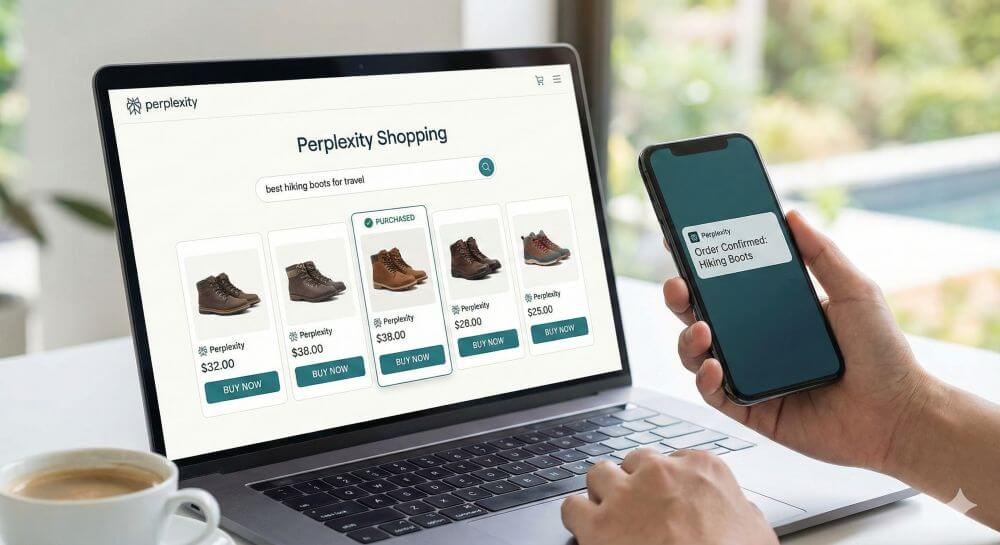
Traditional search engines (like Google) are signposts. They tell you, “The answer might be here, go read it there.” GenAI tools (like Perplexity, ChatGPT Search, or Gemini) are analysts. They say, “I’ve read these five sources, and here’s the summary of the answer for you.” This saves you the cognitive effort of piecing information together yourself.
Three concrete use cases for your office
What does this look like in practice? Here are three scenarios where AI outperforms traditional search:
A. The quick market overview (spreadsheet power)
Do you need to compare different CRM systems?
- Alt: Open the providers’ websites, search for pricing pages, and manually transfer features to Excel.
- New (Prompt): “Compare Salesforce, HubSpot, and Pipedrive for a small service company (10 employees). Create a table with the columns: Cost per user, Key benefits, Biggest drawbacks, and Integrations.” The result is an almost complete decision matrix in seconds.
B. The “Deep Dive” into Specialist Topics
Do you need to delve into a complex topic (e.g., ESG guidelines)?
- Old: Read technical articles that often assume too much prior knowledge.
- New (Prompt): “Explain the new ESG reporting requirements for SMEs. Start with a summary for laypeople and then go into detail about the points that are relevant for the IT department.” You can ask follow-up questions (“What does this mean specifically for server hosting?”) as if you were chatting with an expert.
C. Document Research (“Chat with your Data”)
Often, the information isn’t on the web, but in a 100-page PDF study. Upload the PDF to your AI tool.
- Prompt: Summarize the key findings of this study on one page and list all the mentioned statistics on the topic of working from home. The AI will become your personal reading assistant.
The tools: Where should you start?
Not every tool excels at everything. Here’s your current setup:
- Perplexity AI: The current gold standard for research. It works like a mix of Google and ChatGPT. It always delivers precise footnotes and source information. Perfect for fact-checking.
- ChatGPT (with Search) / Gemini: The all-rounders. Strong in writing and creativity, but now rapidly catching up in web search.
- Consensus (for academics): An AI search engine that exclusively searches scientific papers. Ideal if you need reliable studies instead of opinions.
The golden rule: Trust is good, verification is essential.
GenAI has a weakness: It wants to please you. If it can’t find an answer, it sometimes invents one (hallucination).
Therefore, the “sandwich process” applies to professional research:
- Human: Defines the question and the context.
- AI: Gathers information, summarizes, and structures it.
- Human: Checks the sources! (Click on the small numbers/links in the AI output.)
Never use GenAI for facts that you publish without verification, but always use it to bring structure to the chaos of the internet.
Comparison: Classic search vs. GenAI research
| criterion | Classic search engine (e.g., Google) | GenAI research (e.g. Perplexity, ChatGPT) |
|---|---|---|
| input | Keywords (e.g., “CRM comparison for medium-sized businesses”) | Complete sentences & context (e.g., “Create a table of advantages and disadvantages of…”) |
| Result | A list of links (“10 blue links”) that you have to click through. | A direct, synthesized answer, summary, or table. |
| Your task | Search for, read, filter and reassemble information independently. | Review the result, refine it, and check the facts. |
| Time required | High (many tabs, lots of reading). | Low (quick overview). |
| Sources | You are directly on the original source. | The AI summarizes (risk of hallucinations → source check necessary!). |
| Perfect for | Navigation (finding the website), shopping, current news, basic facts. | Understanding complex topics, comparisons, summaries, brainstorming. |
Conclusion: Upgrade to Knowledge Worker 2.0
Anyone still conducting research solely by manually clicking through search results is working in slow motion. With GenAI, you outsource the “searching and sorting” and focus on “understanding and deciding.”
Try it with your next project: Instead of opening Google, launch your chatbot. You’ll wonder how you ever did it differently.

Beliebte Beiträge

Create annual calendar 2022 in Excel
In our tutorial we describe how you can create an annual calendar for 2022 with a display of the calendar week and public holidays in Excel, and use it anew every year.

YouTube advertising for private videos without consent
And on YouTube, too, users have had to get used to more and more advertising over time. But in the future it could get even more dramatic, and maybe get more people to subscribe to YouTube Premium.
Create individual charts in Excel
Charts are created quickly in Microsoft Excel. We explain how you can customize them, and also swap (transpose) the axes.

How to correctly write a review on Google
A community lives from participating. Don't just read reviews on Google, write your own. But please pay attention to what you write

The new Amazon 4K Fire TV Stick in the field test
Therefore, the switch is also worthwhile for owners of older Fire TV devices, and owners of Smart TV's

Create professional letter templates in Word
How to create a professional letter template with form fields in Microsoft Word, and only have to fill in text fields.
Offers 2024: Word & Excel Templates