Thousands of Chip Factories in China are shutting down


According to a report by DigiTimes, about 10,000 Chinese companies specializing in chip development have shut down operations between 2021 and 2022.
As part of the “Made in China 2025” strategy, the Chinese government has made increased efforts to strengthen the domestic semiconductor industry. This has led to a wave of start-ups in recent years, creating thousands of new companies in the chip industry. However, this strategy didn’t really work for various reasons, which is why most of their plants have now closed again.
Thousands of Chip Factories in China are shutting down
According to a report by DigiTimes, about 10,000 Chinese companies specializing in chip development have shut down operations between 2021 and 2022.
As part of the “Made in China 2025” strategy, the Chinese government has made increased efforts to strengthen the domestic semiconductor industry. This has led to a wave of start-ups in recent years, creating thousands of new companies in the chip industry. However, this strategy didn’t really work for various reasons, which is why most of their plants have now closed again.
China’s dependence on imported chips remains
China’s dependence on imported chips remains
In 2014, China launched the US$22 billion National Integrated Circuit Industry Investment Fund, also known as the “Big Fund“, as part of the “Made in China 2025” strategy to reduce its dependence on imported chips to reduce. So far, however, there has been no success. Currently, only 16 percent of semiconductors in China are locally produced, and these are among the least demanding in each category. Last year, China announced a second “big fund” to invest another $29 billion in semiconductor development. Despite these efforts, China still imports about 90 percent of the chips it needs.
The closure of the chip manufacturers has very different reasons. For example, there has been significant abuse of subsidies and corruption in the past. In addition, the “human factor” plays a crucial role: many new Chinese companies did not have the necessary management know-how to design or manufacture competitive chips. In addition, there is a lack of sufficiently qualified specialists in China who can work in this high-tech field. The largest chip manufacturer in the world remains the undisputed Samsung based in South Korea.
China’s zero-Covid policy has also contributed to the bankruptcy wave, as it led to a collapse in production and consumption in many developed countries around the world last year, severely affecting demand for domestic chips. In addition, US sanctions prevent the import of urgently needed technology and know-how to China.
The most advanced Chinese chip company is Semiconductor Manufacturing International Corporation (SMIC), based in Shanghai. Similar to Huawei, SMIC is on US Departments of Commerce and Defense watch lists, severely limiting its access to US technology and funding. Without foreign support, SMIC is still a long way from making a chip like the Kirin 9000 for smartphones, for example.
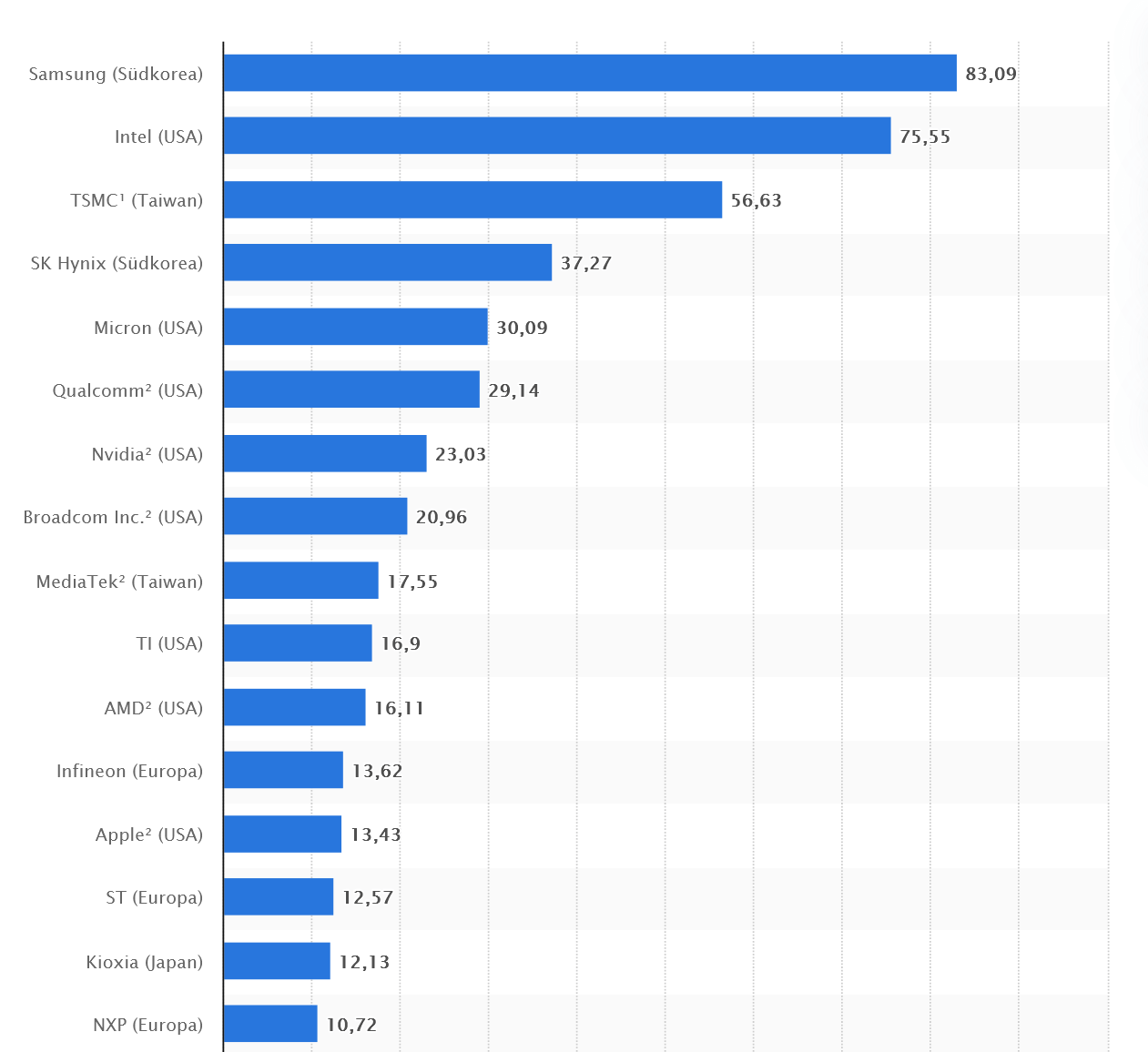
Source: Statista
Wie Albert Einstein schon sehr treffend sagte: “Die Definition von Wahnsinn ist, immer das Gleiche zu tun und andere Ergebnisse zu erwarten”
The Kirin 9000, like other leading CPUs, was designed for silicon wafers that are five nanometers in size. In the case of semiconductors, the smaller the better. Currently, SMIC can only produce 14 nanometer chips. Although plans have been announced for making seven nanometer chips, they lack the appropriate machinery and tooling to make those plans a reality.
In an interview with Discourse, George Calhoun, a professor at the Stevens Institute of Technology in New Jersey, describes the “Beijing art of failure“: It is a top-down, Soviet-style program in which a lot of money is invested and Subsidies are provided for all. This has already been tried several times. In the latest round, Beijing rolled out a new set of incentives for semiconductor companies.
As Albert Einstein once said, “The definition of insanity is doing the same thing over and over and expecting different results.”
In 2014, China launched the US$22 billion National Integrated Circuit Industry Investment Fund, also known as the “Big Fund“, as part of the “Made in China 2025” strategy to reduce its dependence on imported chips to reduce. So far, however, there has been no success. Currently, only 16 percent of semiconductors in China are locally produced, and these are among the least demanding in each category. Last year, China announced a second “big fund” to invest another $29 billion in semiconductor development. Despite these efforts, China still imports about 90 percent of the chips it needs.
The closure of the chip manufacturers has very different reasons. For example, there has been significant abuse of subsidies and corruption in the past. In addition, the “human factor” plays a crucial role: many new Chinese companies did not have the necessary management know-how to design or manufacture competitive chips. In addition, there is a lack of sufficiently qualified specialists in China who can work in this high-tech field. The largest chip manufacturer in the world remains the undisputed Samsung based in South Korea.
China’s zero-Covid policy has also contributed to the bankruptcy wave, as it led to a collapse in production and consumption in many developed countries around the world last year, severely affecting demand for domestic chips. In addition, US sanctions prevent the import of urgently needed technology and know-how to China.
The most advanced Chinese chip company is Semiconductor Manufacturing International Corporation (SMIC), based in Shanghai. Similar to Huawei, SMIC is on US Departments of Commerce and Defense watch lists, severely limiting its access to US technology and funding. Without foreign support, SMIC is still a long way from making a chip like the Kirin 9000 for smartphones, for example.
Source: Statista
Wie Albert Einstein schon sehr treffend sagte: “Die Definition von Wahnsinn ist, immer das Gleiche zu tun und andere Ergebnisse zu erwarten”
The Kirin 9000, like other leading CPUs, was designed for silicon wafers that are five nanometers in size. In the case of semiconductors, the smaller the better. Currently, SMIC can only produce 14 nanometer chips. Although plans have been announced for making seven nanometer chips, they lack the appropriate machinery and tooling to make those plans a reality.
In an interview with Discourse, George Calhoun, a professor at the Stevens Institute of Technology in New Jersey, describes the “Beijing art of failure“: It is a top-down, Soviet-style program in which a lot of money is invested and Subsidies are provided for all. This has already been tried several times. In the latest round, Beijing rolled out a new set of incentives for semiconductor companies.
As Albert Einstein once said, “The definition of insanity is doing the same thing over and over and expecting different results.”
Popular Posts:

5 simple security rules against phishing and spam that everyone should know
Deceptively authentic emails from your bank, DHL, or PayPal? That's phishing! Data theft and viruses are a daily threat. We'll show you 5 simple rules (2FA, password managers, etc.) to protect yourself immediately and effectively and help you spot scammers.

The 5 best tips for a clean folder structure on your PC and in the cloud
Say goodbye to file chaos! "Offer_final_v2.docx" is a thing of the past. Learn 5 simple tips for a perfect folder structure on your PC and in the cloud (OneDrive). With proper file naming and archive rules, you'll find everything instantly.

Never do the same thing again: How to record a macro in Excel
Tired of repetitive tasks in Excel? Learn how to create your first personal "magic button" with the macro recorder. Automate formatting and save hours – no programming required! Click here for easy instructions.

IMAP vs. Local Folders: The secret to your Outlook structure and why it matters
Do you know the difference between IMAP and local folders in Outlook? Incorrect use can lead to data loss! We'll explain simply what belongs where, how to clean up your mailbox, and how to archive emails securely and for the long term.

Der ultimative Effizienz-Boost: Wie Excel, Word und Outlook für Sie zusammenarbeiten
Schluss mit manuellem Kopieren! Lernen Sie, wie Sie Excel-Listen, Word-Vorlagen & Outlook verbinden, um personalisierte Serien-E-Mails automatisch zu versenden. Sparen Sie Zeit, vermeiden Sie Fehler und steigern Sie Ihre Effizienz. Hier geht's zur einfachen Anleitung!

Agentic AI: The next quantum leap in artificial intelligence?
Forget simple chatbots! Agentic AI is here: Autonomous AI that plans, learns, and solves complex tasks for you. Discover how AI agents will revolutionize the world of work and your everyday life. Are you ready for the future of artificial intelligence?
Offers 2024: Word & Excel Templates




Popular Posts:
5 simple security rules against phishing and spam that everyone should know
Deceptively authentic emails from your bank, DHL, or PayPal? That's phishing! Data theft and viruses are a daily threat. We'll show you 5 simple rules (2FA, password managers, etc.) to protect yourself immediately and effectively and help you spot scammers.
The 5 best tips for a clean folder structure on your PC and in the cloud
Say goodbye to file chaos! "Offer_final_v2.docx" is a thing of the past. Learn 5 simple tips for a perfect folder structure on your PC and in the cloud (OneDrive). With proper file naming and archive rules, you'll find everything instantly.
Never do the same thing again: How to record a macro in Excel
Tired of repetitive tasks in Excel? Learn how to create your first personal "magic button" with the macro recorder. Automate formatting and save hours – no programming required! Click here for easy instructions.
IMAP vs. Local Folders: The secret to your Outlook structure and why it matters
Do you know the difference between IMAP and local folders in Outlook? Incorrect use can lead to data loss! We'll explain simply what belongs where, how to clean up your mailbox, and how to archive emails securely and for the long term.
Der ultimative Effizienz-Boost: Wie Excel, Word und Outlook für Sie zusammenarbeiten
Schluss mit manuellem Kopieren! Lernen Sie, wie Sie Excel-Listen, Word-Vorlagen & Outlook verbinden, um personalisierte Serien-E-Mails automatisch zu versenden. Sparen Sie Zeit, vermeiden Sie Fehler und steigern Sie Ihre Effizienz. Hier geht's zur einfachen Anleitung!
Agentic AI: The next quantum leap in artificial intelligence?
Forget simple chatbots! Agentic AI is here: Autonomous AI that plans, learns, and solves complex tasks for you. Discover how AI agents will revolutionize the world of work and your everyday life. Are you ready for the future of artificial intelligence?
Offers 2024: Word & Excel Templates