A quiet farewell: Why the end of Google Assistant was inevitable


Do you remember the classic “Hey Google, what’s the weather like?” and the robotic reply that followed? Today, in late autumn 2025, it seems like a relic from a bygone era. The Google Assistant, once the heart of the Android ecosystem and the mastermind behind millions of smart homes, is effectively history.
It wasn’t shut down with a bang, but rather replaced by a gradual yet radical evolution. Its successor, Gemini, has completely taken over. But why did the faithful assistant have to make way? A look at the transformation.
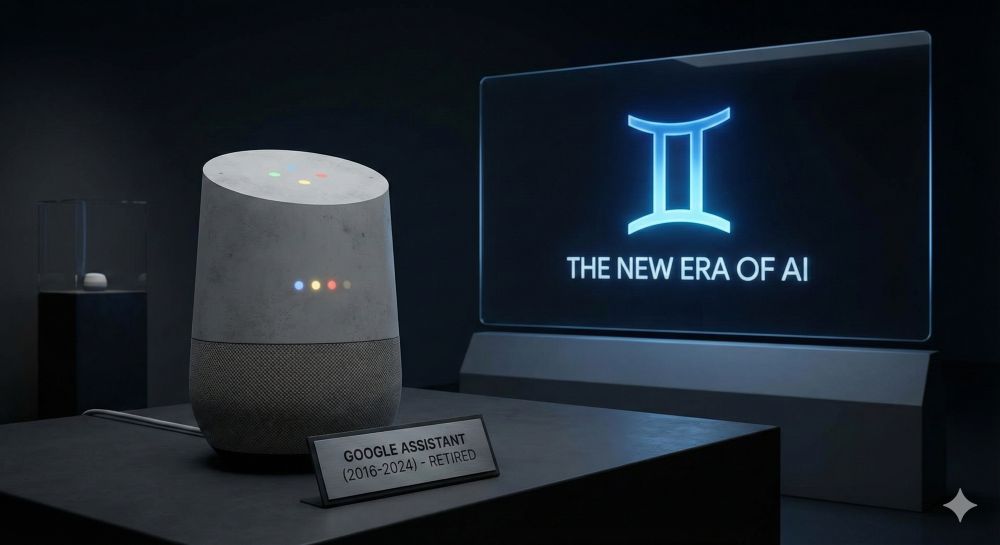
From order receiver to thought partner
The original Google Assistant (launched in 2016) was based on a simple principle: command and execution. It was a master at running scripts.
- “Set the timer for 10 minutes.”
- “Play music on Spotify.”
The problem? It didn’t understand the world. It only understood keywords. As soon as a question became more complex or required context (“Do you remember the restaurant my brother recommended last week?”), the old Assistant hit a wall.
The turning point: With the rise of Large Language Models (LLMs) in 2023 and 2024, user expectations changed dramatically. We no longer wanted to dictate; we wanted to converse. Google realized that the Assistant’s old code base was incapable of providing this cognitive flexibility. It had to die so that Gemini could live.
The difficult transition phase (2024–2025)
The transition was anything but smooth at first. Many users will remember 2024, when Google began pushing Gemini on smartphones.
- The latency problem: Initially, Gemini took too long to do simple things like turn on the lights because the request had to be routed through massive cloud models.
- Loss of functionality: Popular, niche Assistant features (like certain routines or third-party integrations) suddenly stopped working.
But today, at the end of 2025, the situation has changed dramatically. Thanks to more powerful NPUs (Neural Processing Units) in modern smartphones (like the Pixel 10 series) and optimized “Gemini Nano” models, most standard commands run locally and lightning fast. The gap between “intelligence” and “speed” has closed.
What we have today: Context is king
The crucial difference between the outdated Assistant and today’s AI standard is multimodal context.
If you look at your phone today and say, “What kind of building is that over there, and is it still open?”, the AI (Gemini) analyzes the camera image, recognizes your location, checks the opening hours, and answers in context. The old Assistant would have simply given you a list of Google search results for the word “building.”
In the smart home, the end of the Assistant means we no longer have to speak like programmers:
- Old: “Hey Google, turn the living room lights down to 50% and play the Jazz playlist.”
- New (2025): “I’m in the mood for a relaxing evening, make it cozy.” – The AI understands the intention, dims the lights, selects suitable music, and might even lower the blinds.
A Look Back: The Legacy of the Assistant
Should we be sad? A little nostalgia is allowed. The Google Assistant made voice control accessible to the masses. It was reliable in its simplicity. There was a time when we knew exactly what it could and couldn’t do. But the tech industry never stands still. The Assistant was a tool of “Web 2.0″—a voice interface for Google Search. Today’s system is an agent. It doesn’t just execute; it plans and acts proactively.
Key milestones of the transition
| Year | Event | Meaning |
|---|---|---|
| 2016 | Start Google Assistant | The beginning of mass-market voice control. |
| 2023 | Bard / Gemini announcement | The beginning of generative AI at Google. |
| 2024 | Gemini replaces the Assistant app | The first step towards replacing it with Android. |
| 2025 | Full integration | Smart speakers and Nest devices primarily run on an LLM basis. |
Conclusion: The king is dead, long live AI!
The term “Google Assistant” might still pop up here and there in old settings menus, but as a product, it no longer exists. It has been absorbed. The end of Google Assistant marks the moment when computers ceased to be rigid machines and began to truly understand us.
It wasn’t a death by failure, but by obsolescence. We traded the Assistant for a partner.

Beliebte Beiträge

The best tips for Microsoft Word
Sparen Sie mit diesen Tipps für Microsoft Word viel Zeit und Nerven. Arbeiten Sie effektiver mit der beliebtesten Textverarbeitungssoftware.

Why is my Excel File so big?
Solve the problem with Excel spreadsheets that take up several megabytes of space without any apparent reason.

The most important tips for Excel
These 10 tips for Microsoft Excel 2016/2019 with questions that many users ask every day are guaranteed to help you and save a lot of time.
More fonts in Word through Google Fonts
You can find out how to expand the font selection in Word with just a few steps and above all free in our article.
Move pages and insert new ones in word
You probably also know the situation that you are sitting on a very long document, and in the middle of it falls on the actually between page 2 and page 3 still a page in between must.
The Sreference and the Wreference in Excel
Microsoft Excel: How to get S-reference and W-reference purposefully data out of a source.
Offers 2024: Word & Excel Templates