From “gap” to agility: Why the zigzag resume is the future


For years, an unwritten rule prevailed in Germany: a resume had to be flawless, career progression linear, and loyalty to an employer almost lifelong. Those who “jumped the boat” were considered unstable. Those who took a break had to justify themselves. But this paradigm is crumbling. Welcome to the age of the portfolio career.
In a rapidly changing work environment, gaps in a career path are no longer seen as flaws, but increasingly as indicators of adaptability (agility) and courage.
The change: Why “straightforward” is outdated
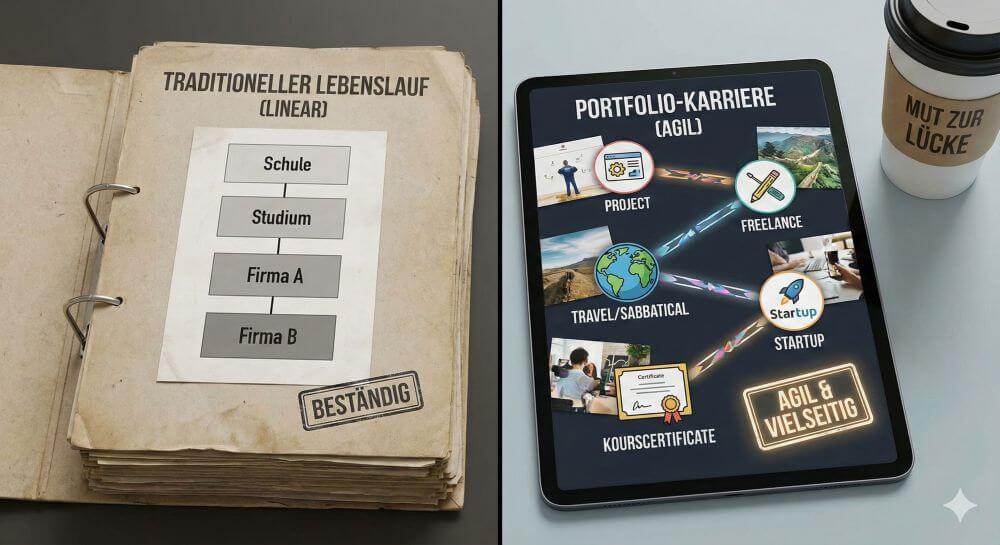
The classic “chimney-climbing” career path—apprenticeship, entry-level position, advancement within the same company until retirement—rarely reflects the reality of the digital economy. Companies today need to be agile, and they seek employees who are just as agile.
A resume with numerous positions or periods of career change often signals:
- High willingness to learn: The candidate has familiarized themselves with various company cultures and software environments.
- Networking skills: Those who change jobs frequently know many people and perspectives.
- Resilience: Gaps in employment (e.g., due to sabbaticals, caregiving leave, or job loss) and successful re-entry demonstrate perseverance.
In the modern HR perspective, the “job hopper” becomes an “experience collector.” Versatility (generalist skills) is valued more highly than pure specialization.
Termination culture in the USA vs. Germany
To understand why we in Germany are still struggling with this change, a comparison with the USA is worthwhile. There, a fundamentally different mentality prevails regarding work and security.
Germany: Security as the Highest Value
Here, the employment contract is often a defining aspect of one’s identity. A dismissal – whether self-initiated or received – is often perceived as a personal failure or social insecurity. The stigma of the “gap” arises from the fear of losing status.
USA: “You’re Fired” Is Not the End of the World
In the USA, the labor market is extremely flexible due to “at-will employment.” Job security is practically nonexistent. This sounds harsh, but it has a downside that fosters innovation:
- Normalization: Since almost everyone gets fired or resigns at some point, there is hardly any stigma. It’s part of the “game.”
- Risk-taking: Those who fail get up and keep going. In the US, a founder who has failed with a company is often considered more experienced than one who never tried.
- Trial and error: US careers are often patchwork. People try things out. This mentality is slowly spreading to us: Failure is not a disgrace, but a source of data for the next success.
What exactly is a portfolio career?
The term goes beyond mere job-hopping. A true portfolio career means no longer making your labor available to just one employer, but rather diversifying your skills like an investment portfolio.
This can take various forms:
- The Slasher: Someone who works simultaneously as a consultant, author, and speaker.
- The Project Nomad: Works intensively on one project for 18 months, then takes a 3-month break, before starting the next project.
- The Hybrid: Part-time employee and part-time entrepreneur.
Important: In a portfolio career, the “gap” in your resume isn’t emptiness. It’s often time spent reinventing yourself, developing your skills, or simply recharging your batteries to give 100% in your next job.
Conclusion: Embrace the gaps
For applicants, this means: Don’t hide your gaps in your career path. Tell the story behind them. Explain what you learned during those “gaps” and why the change was necessary for your growth.
For companies, this means: Those seeking innovation shouldn’t be looking for perfectly polished resumes. The most exciting talent often comes from those with unique and unconventional profiles.

Beliebte Beiträge
Create vacation planner in Excel
We explain how you can create your own vacation planner 2022 in Microsoft Excel. And of course with a display of public holidays and weekends.
Create annual calendar 2022 in Excel
In our tutorial we describe how you can create an annual calendar for 2022 with a display of the calendar week and public holidays in Excel, and use it anew every year.
Create individual charts in Excel
Charts are created quickly in Microsoft Excel. We explain how you can customize them, and also swap (transpose) the axes.
Create professional letter templates in Word
How to create a professional letter template with form fields in Microsoft Word, and only have to fill in text fields.
Create a digital signature in Outlook and Word
Create a digital signature in Microsoft Outlook and Word for more security.

Create a Table of Contents in Word
To create a dynamic table of contents in Microsoft Word - Office 365
Offers 2024: Word & Excel Templates