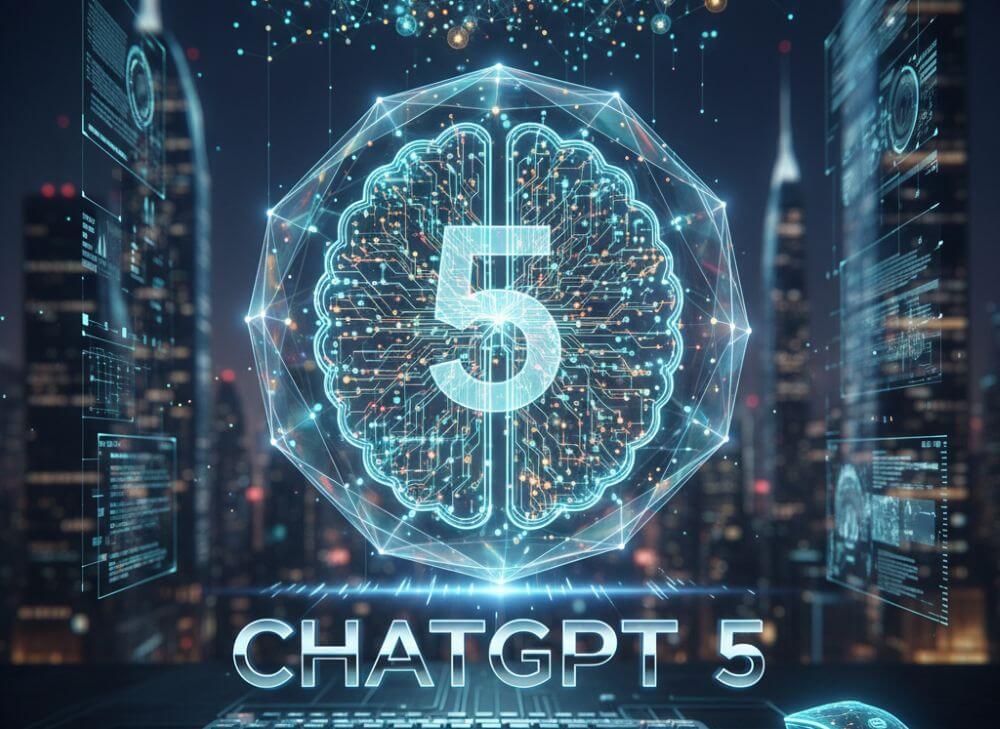
What is GPT-5? Everything we know about the next big AI leap.

The world of artificial intelligence is moving at a breathtaking pace. While many companies and users are still busy exploring the full potential of GPT-4 (and its variants like GPT-40), the tech world is already looking ahead to the next major milestone: GPT-5.
OpenAI, the company behind ChatGPT, is keeping its specifics under wraps, but interviews, research papers, and industry rumors are gradually revealing more. What can we expect from this next “big leap”?
The status quo: Where do we stand?
Before we look to the future, a brief review is worthwhile.
- GPT-3 (2020): The breakthrough. The model demonstrated that AI can generate human-like text.
- GPT-3.5 (end of 2022): The foundation for ChatGPT’s viral success. Fast, affordable, and good at dialogue.
- GPT-4 (2023): A massive leap in logic, nuance, and multimodality (understanding images).
- GPT-4o (“Omni”, 2024): Focus on speed and seamless integration of audio, image, and text in real time.
GPT-5 (or whatever the final name will be, often discussed internally as “Gobi” or similar code names) is not intended to be just an incremental improvement, but, according to OpenAI CEO Sam Altman, a significant leap in cognitive performance.
What makes GPT-5 different? Key expectations
Experts expect GPT-5 to address fundamental problems of today’s Large Language Models (LLMs).
A. Improved Reasoning & Reliability
- The biggest shortcoming of current AIs is hallucination—the fabrication of facts.
- The goal: GPT-5 should be significantly better at constructing logical chains and accurately reproducing facts.
- Sam Altman’s analogy: He compared the leap from GPT-4 to GPT-5 to the difference between a bright high school student and a PhD expert. The model should develop a deeper understanding of complex relationships, instead of simply calculating probabilities of word sequences.
B. True Personalization and Memory
- Current models often “forget” details from long conversations or don’t know the user’s specific preferences well enough.
- GPT-5 is expected to have long-term memory. It will remember projects you were working on three weeks ago and maintain your style and preferences across all chats.
C. Multimodality as the Standard
- While GPT-40 is already multimodal, GPT-5 will further blur these boundaries.
- The model is expected to treat video, audio, image, and text not as separate modules, but as a single, flowing source of information—much like a person who sees, hears, and reads simultaneously.
D. Agent Capabilities (Agency)
- This is perhaps the most important point for business.
- Today: You ask the AI to write an email and then copy it into your email program.
- Tomorrow (GPT-5): You tell the AI, “Organize a meeting with the marketing team and book a room.” The AI (as an agent) checks calendars, sends invitations, reserves the room, and prepares the agenda—autonomously.
The topic “AGI”: Are we there yet?
One term that repeatedly comes up in discussions about GPT-5 is AGI (Artificial General Intelligence) – that is, an artificial general intelligence that is intellectually equal to or superior to humans in almost all areas.
Is GPT-5 an AGI? Probably not quite yet. Most experts believe that GPT-5 is another step towards AGI, but not yet the point at which the machine achieves true consciousness or complete autonomy in unknown situations. It is seen more as an extremely powerful tool capable of superhuman performance in specific areas (programming, medicine, law).
When can we expect the release?
This is where speculation abounds and facts are scarce.
Original Rumours: Many hoped for a release by the end of 2023 or the beginning of 2024.
Current Assessment: OpenAI has repeatedly emphasized that they are taking their time. Security testing (“red teaming”) is their top priority. A release between the end of 2025 and mid-2026 seems realistic, possibly followed by a phased rollout for enterprise customers.
The “Strawberry” (o1) Factor: OpenAI recently released new model series (such as o1-preview) that specialize in “reasoning.” It is possible that the insights gained from these models will need to be fully incorporated into the final GPT-5.
Challenges and risks
With greater power come greater problems. The development of GPT-5 faces massive hurdles:
Computing Power and Energy
- Training these models consumes unimaginable amounts of energy and hardware.
- It is rumored that Microsoft and OpenAI are working on a supercomputer project called “Stargate,” which could cost up to $100 billion to secure the infrastructure for future models (GPT-6 and beyond).
Data Quality
- The Internet will soon be “read dry.” AIs have already consumed almost all the high-quality texts on the open web.
- The solution: OpenAI is increasingly relying on partnerships with media companies (e.g., Axel Springer, Financial Times) and the generation of synthetic training data to further feed the model.
Security and Regulation
- The more The more capable the AI, the more dangerous its misuse (e.g., for bioweapons instructions or perfect cyberattacks). OpenAI is under massive pressure from governments (EU AI Act) to ensure that GPT-5 remains controllable.
Conclusion: Evolution or revolution?
GPT-5 is not expected to be a “magical” new invention that appears out of thin air. It will feel more like going from a somewhat slow, occasionally confused assistant to a highly competent, proactive employee.
The leap will lie less in the “creativity” of the text and more in the reliability of the work. If GPT-5 is able to perform complex tasks for hours on end without errors or constant follow-up, it will change the world of work even more drastically than GPT-4 did.

Beliebte Beiträge
Create vacation planner in Excel
We explain how you can create your own vacation planner 2022 in Microsoft Excel. And of course with a display of public holidays and weekends.
Create annual calendar 2022 in Excel
In our tutorial we describe how you can create an annual calendar for 2022 with a display of the calendar week and public holidays in Excel, and use it anew every year.
Create individual charts in Excel
Charts are created quickly in Microsoft Excel. We explain how you can customize them, and also swap (transpose) the axes.
Create professional letter templates in Word
How to create a professional letter template with form fields in Microsoft Word, and only have to fill in text fields.
Create a digital signature in Outlook and Word
Create a digital signature in Microsoft Outlook and Word for more security.

Create a Table of Contents in Word
To create a dynamic table of contents in Microsoft Word - Office 365
Offers 2024: Word & Excel Templates