Digital detox at work: The art of conscious unavailability


It flashes, vibrates, and pings. The modern workplace is often no longer a place of concentration, but rather a hub for distractions. Emails, Slack messages, Zoom calls, and our personal smartphones vie for our attention every second.
The result: Fragmented workdays, declining productivity, and a permanently elevated stress level. Digital detox at work doesn’t mean throwing your computer out the window. It’s about regaining control over technology, instead of being controlled by it.

Why we need to “pull the plug”
Our brains aren’t designed for multitasking. Every time we’re pulled away from a task—even just to quickly glance at a push notification—studies show our brains need up to 23 minutes to regain full focus.
Constant availability (the always-on mentality) leads to the following in the long run:
- Cognitive fatigue: Decisions become more difficult.
- Decreased quality: Careless mistakes increase.
- Lack of recovery: Those who never switch off burn out.
Productivity isn’t measured by the speed of response, but by the quality of the result.
5 Strategies for Digital Detox in Everyday Work
You don’t have to move to a monastery for three weeks to feel the effects. Integrate “micro-detox” strategies into your day:
1. Break the power of notifications
The simplest and most effective step: Turn off all non-critical push notifications.
- No email pop-ups on your desktop.
- No social media updates on your lock screen.
- Mute group chats that aren’t immediately relevant.
2. Batch emails instead of constantly bombarding your inbox
Instead of answering every email immediately, batch your processing. Set specific times (e.g., 9:00 AM, 1:00 PM, and 4:30 PM) to empty your inbox. Keep the program closed the rest of the time. 3. Block out Deep Work Time
- Set aside 60 to 90 minutes each day for focused work (deep work).
- Mark this time as “Booked” in your calendar.
- Activate “Do Not Disturb” mode in Teams or Slack.
- Communicate clearly: “I’ll be back at 11:00 AM.”
3. Block out Deep Work Sessions
- Set aside 60 to 90 minutes each day for focused work (deep work).
- Mark this time as “Booked” in your calendar.
- Activate “Do Not Disturb” mode in Teams or Slack.
- Communicate clearly: “I’ll be back at 11:00 AM.”
4. Banish Your Smartphone
Your smartphone should not be on your desk while you work. Studies show that the mere physical presence of the device (even when it’s switched off) ties up cognitive resources (“brain drain”). Put it in a drawer or your bag.
5. Take Analog Breaks
Use your lunch break for a real reset. No eating in front of a screen, no scrolling through Instagram. Go outside, look into the distance, or read a book. Give your eyes and brain a break from the pixels.
A word to leaders: Lead by example in cultural change
Digital detox only works to a limited extent if your boss expects a response within five minutes. Leaders need to establish a culture of focused time. If you write emails on the weekend, use the “send later” function to avoid putting pressure on your employees.
Conscious rather than automatic
Digital detox at work is a training in mindfulness. It’s about using technology again as a tool that serves us—not as a pacemaker that drives us. Those who learn to be temporarily unavailable become indispensable in the long run because the quality of their work increases.

Beliebte Beiträge

Warum dein Excel-Kurs Zeitverschwendung ist – was du wirklich lernen solltest!
Hand aufs Herz: Wann hast du zuletzt eine komplexe Excel-Formel ohne Googeln getippt? Eben. KI schreibt heute den Code für dich. Erfahre, warum klassische Excel-Trainings veraltet sind und welche 3 modernen Skills deinen Marktwert im Büro jetzt massiv steigern.
Microsoft Loop in Teams: The revolution of your notes?
What exactly are these Loop components in Microsoft Teams? We'll show you how these "living mini-documents" can accelerate your teamwork. From dynamic agendas to shared, real-time checklists – discover practical use cases for your everyday work.

Career booster 2026: These Microsoft Office skills will take you further!
A new year, new career opportunities! But which Office skills will really be in demand in 2026? "Skilled use" is no longer enough. We'll show you today's must-haves – like advanced Excel, using AI in the office, and relevant certifications for your resume.

Excel Tutorial: How to quickly and safely remove duplicates
Duplicate entries in your Excel lists? This distorts your data. Our tutorial shows you, using a practical example, how to clean up your data in seconds with the "Remove Duplicates" function – whether you want to delete identical rows or just values in a column.
Dynamic ranges in Excel: OFFSET function
The OFFSET function in Excel creates a flexible reference. Instead of fixing =SUM(B5:B7), the function finds the range itself, e.g., for the "last 3 months". Ideal for dynamic charts or dashboards that grow automatically.
Mastering the INDIRECT function in Excel
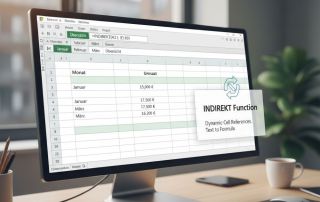
The INDIRECT function in Excel converts text into a real reference. Instead of manually typing =January!E10, use =INDIRECT(A2 & "!E10"), where A2 contains 'January'. This allows you to easily create dynamic summaries for multiple worksheets.
Offers 2024: Word & Excel Templates