Vodafone earthquake at DE-CIX: The end of the open network?


It’s news that’s causing quite a stir in the German and European networking community and calling into question the established structure of internet exchange: Vodafone Germany is ending its public peering strategy. The company is thus effectively withdrawing from the open exchange architecture of large, public internet exchange points (IXPs) like DE-CIX in Frankfurt, the world’s largest.
This move, which according to industry media (as reported by Golem.de in early November 2025) is already underway, is not a simple technical process, but a profound commercial and strategic realignment. Vodafone isn’t severing its connection to the internet, but fundamentally changing how and under what conditions other networks are allowed to exchange data with its millions of end customers.

What exactly is happening? The end of public peering.
To understand the implications of this decision, one must consider the current status quo at internet exchange points:
The previous model (public peering): Large internet service providers (ISPs) like Vodafone, content providers (such as Netflix or smaller streaming services), and hundreds of other networks meet at neutral locations, the Internet Exchange Points (IXPs) like DE-CIX. There, they connect their networks via a central switch. They practice “public peering”—a mostly settlement-free exchange of data traffic for mutual benefit. Anyone sending data to Vodafone customers could do so directly and efficiently at the IXP.
The new approach (outsourcing & monetization): Vodafone is now terminating these public peering agreements. Instead, the company is outsourcing these connections to an exclusive partner: the Berlin-based company Inter.link.
Anyone wishing to feed data traffic directly into the Vodafone network in the future must do so via Inter.link. This service, unlike the previous public peering, will be subject to a fee.
It’s important to distinguish this: Vodafone is not ending private peering. Direct, private connections to the “hyperscalers”—the absolute giants like Google, Amazon (AWS), and Microsoft (Azure)—will continue and be optimized. The strategic withdrawal concerns the “open door” for hundreds of medium-sized and smaller networks on the public marketplace.
The strategy: Why Vodafone is taking this step
Vodafone’s decision is not primarily driven by technical considerations, but rather by commercial ones. It follows a trend that Deutsche Telekom initiated years ago: the monetization of its own network access.
The underlying calculation is simple:
- Value of the “Eyeball Network”: Vodafone is a so-called “eyeball network” (eyeball = eyeball). It has direct access to millions of paying end customers who want to consume content.
- The “Toll Station”: Content providers (from streaming services to gaming platforms) depend on delivering their data quickly and with high quality to these “eyeballs.”
- The New Reality: Until now, the direct route via public peering at DE-CIX was essentially a free highway entrance. Vodafone is now replacing this with a toll station operated by its partner Inter.link.
Vodafone argues that it wants to “optimize” its connections. Critics, however, see this as a clear attempt to charge a fee for access to their own customers. Smaller providers who cannot or will not pay Inter.link’s fees will be excluded in the future.
Who is the new partner Inter.link?
The new exclusive partner, Inter.link, is a Berlin-based network operator and peering provider, founded in 2020. The company provides an automated platform through which other networks can book capacity on the Vodafone network. Inter.link itself acts as a participant at the major network nodes, but functions for Vodafone as a kind of “gatekeeper” and billing service provider.
Possible consequences for the internet and its users
This change in strategy is another step away from the “open,” cooperative spirit that made internet exchange points great, toward a fragmented “internet of closed gardens.”
1. Consequences for other network operators: For medium-sized and small content providers, cloud services, or specialized hosting providers, this represents a massive change. They now have two bad options:
- They pay the new fees to Inter.link, which increases their operating costs.
- They don’t pay, and their data traffic has to take a longer, more expensive, and slower route via so-called “transit providers” to reach Vodafone customers.
2. Consequences for net neutrality: The debate about net neutrality is reignited. While data traffic within the Vodafone network will (presumably) be treated neutrally, access to the network is now clearly being commercialized. A “two-tier internet” is emerging: Those who pay get the fast, direct connection; Those who don’t pay have to take the detour.
3. Consequences for Vodafone customers: Vodafone customers will likely not notice any immediate effects from this change. Connections to the giants (Google, Netflix, Amazon), which account for the majority of traffic, will remain fast via private peering.
However, the risk lies in the details: If a customer uses a smaller, European cloud service, a specific gaming platform, or a niche streaming provider that chooses not to pay Inter.link, the connection to that service could become noticeably slower for the Vodafone customer (higher latency/ping).
Conclusion: Efficiency optimization or digital customs?
Vodafone’s withdrawal from public peering is a bombshell that shifts the balance of power in the internet backbone. While the company portrays the move as an “optimization,” many network experts see it as a consistent attempt to monetize its market power as an “eyeball network.”
For neutral internet exchange points like DE-CIX, this represents a loss of significance, as their role as an open marketplace is being undermined by the largest players. For the internet as a whole, it means further fragmentation, increasing the costs of data exchange and raising the barriers to new, innovative services.

Beliebte Beiträge

Warum dein Excel-Kurs Zeitverschwendung ist – was du wirklich lernen solltest!
Hand aufs Herz: Wann hast du zuletzt eine komplexe Excel-Formel ohne Googeln getippt? Eben. KI schreibt heute den Code für dich. Erfahre, warum klassische Excel-Trainings veraltet sind und welche 3 modernen Skills deinen Marktwert im Büro jetzt massiv steigern.

Microsoft Loop in Teams: The revolution of your notes?
What exactly are these Loop components in Microsoft Teams? We'll show you how these "living mini-documents" can accelerate your teamwork. From dynamic agendas to shared, real-time checklists – discover practical use cases for your everyday work.

Career booster 2026: These Microsoft Office skills will take you further!
A new year, new career opportunities! But which Office skills will really be in demand in 2026? "Skilled use" is no longer enough. We'll show you today's must-haves – like advanced Excel, using AI in the office, and relevant certifications for your resume.

Excel Tutorial: How to quickly and safely remove duplicates
Duplicate entries in your Excel lists? This distorts your data. Our tutorial shows you, using a practical example, how to clean up your data in seconds with the "Remove Duplicates" function – whether you want to delete identical rows or just values in a column.

Dynamic ranges in Excel: OFFSET function
The OFFSET function in Excel creates a flexible reference. Instead of fixing =SUM(B5:B7), the function finds the range itself, e.g., for the "last 3 months". Ideal for dynamic charts or dashboards that grow automatically.
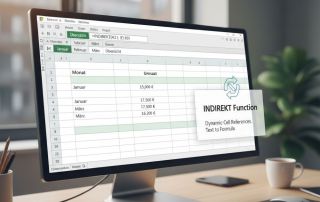
Mastering the INDIRECT function in Excel
The INDIRECT function in Excel converts text into a real reference. Instead of manually typing =January!E10, use =INDIRECT(A2 & "!E10"), where A2 contains 'January'. This allows you to easily create dynamic summaries for multiple worksheets.
Offers 2024: Word & Excel Templates