The end of dumb NPCs: AI brings true long-term memory


Every gamer knows that moment: You save an entire village from a dragon, are hailed as a hero—and five minutes later, the same NPC asks you if you’re often in the Cloud District, as if they’ve never seen you before.
For decades, NPCs (non-player characters) were essentially just nicely decorated signposts with limited scripts. They were walking billboards, reciting text. But we’re on the cusp of a massive shift. Through the integration of generative AI and advanced memory models, NPCs are gaining a true, persistent memory for the first time.
This isn’t just a gimmick. It’s the next big step in the evolution of immersion.
From script trees to neural networks
Previously, dialogues in RPGs like The Witcher or Mass Effect were based on so-called “dialogue trees.” Developers had to manually write every possible response and consequence. This limited freedom: you could only say what the developers had intended.
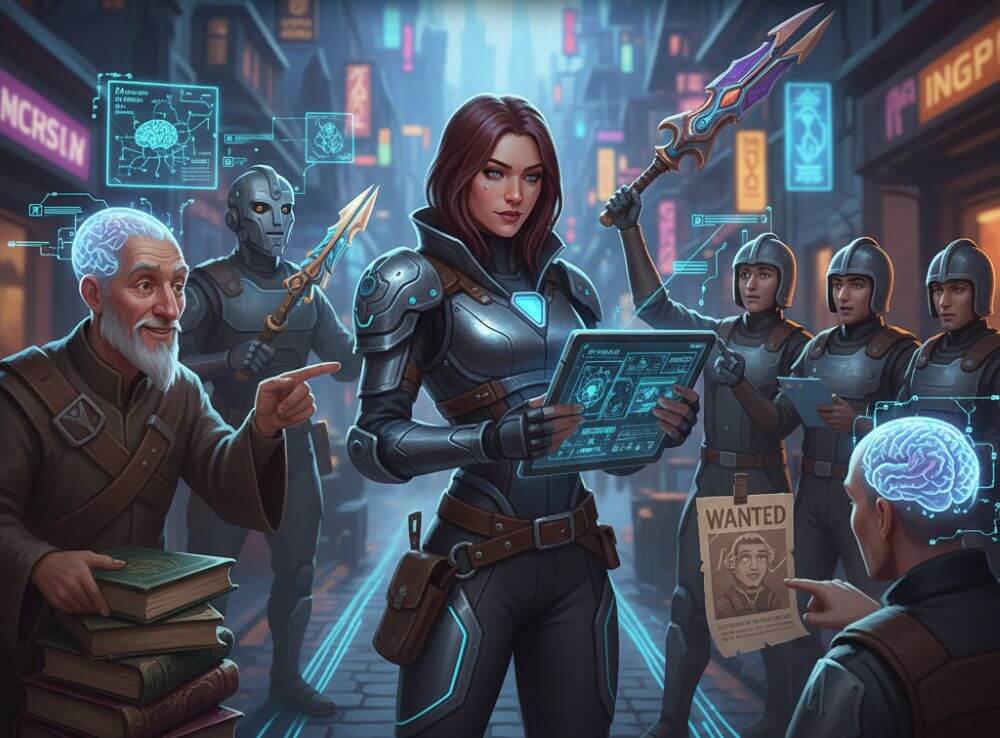
The new generation of NPCs works differently. They use Large Language Models (LLMs) in combination with vector databases.
- No script: The NPC doesn’t have a fixed script, but rather a “personality” (prompt) and access to dynamic “knowledge.”
- Long-term memory: Everything you do or say is stored and linked to the context.
- Dynamic response: When you speak to the NPC, the AI generates the response in real time, based on your shared history.
What does this mean specifically for the gameplay?
The impact on game design is enormous. We’re moving away from games we consume and toward worlds we truly inhabit. Here are the three areas that will change the most:
1. Real Social Consequences
In Skyrim, if you steal from a merchant and get caught, you pay a fine, and the system resets your status. With AI memory, that merchant could hold a grudge.
- He might refuse to sell you valuable items later.
- He might tell other NPCs that you’re untrustworthy (organic reputation systems).
- He might confront you about it weeks later in a tavern if you try to be nice.
2. Emergent Storytelling
Quests no longer need to be rigid. An NPC might give you a task based entirely on a conversation you had ten hours ago.
- Example: You told an NPC that you hate swords and prefer bows. Later, this NPC finds a rare bow and saves it especially for you instead of giving you generic loot.
3. The End of the “Wikipedia NPCs”
- In detective games or RPGs, you often have to click through all the dialogue options to get information (“Tell me about [X]”). With a real memory, you actually have to convince the NPC. You have to build trust. If you insulted them in the first conversation, they won’t tell you the bunker password in the second conversation—no matter how high your Charisma score is on paper.
Who is driving the technology forward?
Two major players and the modding scene are leading the way here:
NVIDIA ACE (Avatar Cloud Engine): Nvidia has already shown demos (like “Kairos”) where you can talk to an NPC via microphone. The NPC responds intelligently, with lip-sync and contextual relevance.
Inworld AI: A platform that helps developers build “brains” for NPCs. Modders have already integrated this technology into Skyrim and GTA V. The result: Viral videos in which NPCs suddenly philosophize about their existential angst. Unreal Engine 5 Plugins: Tools like “Smart NPCs” bring ChatGPT-like APIs directly into the game engine.
Why we still have to wait
Before the hype gets out of hand: There are massive technical hurdles for AAA studios.
- Latency (delay): When you speak, your voice has to be converted into text, sent to a server, processed, and then sent back as audio. This often takes another 1-2 seconds. In a fast-paced shooter, this breaks the immersion.
- Costs: Every API call to an AI costs computing power and therefore money. A game with 100 hours of gameplay and thousands of dialogues would currently be extremely expensive for publishers to maintain.
- “Hallucinations”: AIs like to invent facts. Imagine an NPC sending you on a quest to a location that doesn’t even exist in the game code, just because the AI thought the name was fitting. That’s every game designer’s nightmare.
- Narrative control: How do you tell a coherent story if the NPC suddenly decides to like the villain or immediately blurts out secret plans?
Conclusion: A new age of role-playing games
Even though we’re still a few years away from perfect, seamless integration, the technology is here. The days when an NPC forgets you’ve just murdered the king simply because you left and re-entered the room are numbered. NPCs are transforming from extras into co-authors of our story.

Beliebte Beiträge

Warum dein Excel-Kurs Zeitverschwendung ist – was du wirklich lernen solltest!
Hand aufs Herz: Wann hast du zuletzt eine komplexe Excel-Formel ohne Googeln getippt? Eben. KI schreibt heute den Code für dich. Erfahre, warum klassische Excel-Trainings veraltet sind und welche 3 modernen Skills deinen Marktwert im Büro jetzt massiv steigern.

Microsoft Loop in Teams: The revolution of your notes?
What exactly are these Loop components in Microsoft Teams? We'll show you how these "living mini-documents" can accelerate your teamwork. From dynamic agendas to shared, real-time checklists – discover practical use cases for your everyday work.

Career booster 2026: These Microsoft Office skills will take you further!
A new year, new career opportunities! But which Office skills will really be in demand in 2026? "Skilled use" is no longer enough. We'll show you today's must-haves – like advanced Excel, using AI in the office, and relevant certifications for your resume.

Excel Tutorial: How to quickly and safely remove duplicates
Duplicate entries in your Excel lists? This distorts your data. Our tutorial shows you, using a practical example, how to clean up your data in seconds with the "Remove Duplicates" function – whether you want to delete identical rows or just values in a column.

Dynamic ranges in Excel: OFFSET function
The OFFSET function in Excel creates a flexible reference. Instead of fixing =SUM(B5:B7), the function finds the range itself, e.g., for the "last 3 months". Ideal for dynamic charts or dashboards that grow automatically.

Mastering the INDIRECT function in Excel
The INDIRECT function in Excel converts text into a real reference. Instead of manually typing =January!E10, use =INDIRECT(A2 & "!E10"), where A2 contains 'January'. This allows you to easily create dynamic summaries for multiple worksheets.
Offers 2024: Word & Excel Templates