From colleague to manager: The 5 best tools for new managers


The transition from team member to manager is one of the most critical career steps. Yesterday you were just a buddy at lunch; today you’re the one approving vacation requests and conducting performance reviews. This role change, often referred to as a “peer-to-boss” transition, presents both psychological and organizational challenges.
Those who successfully navigate this leap don’t rely solely on intuition. Successful “new leaders” utilize specific frameworks and methods to build acceptance, set goals, and keep their teams productive. Here are five essential tools to help new managers lead with confidence.

The challenge: Why the transition is so difficult
Before we get to the tools, it’s important to understand the problem. The phrase “What was a casual chat yesterday is an order today” perfectly describes the dilemma. New leaders often struggle on three fronts:
- Loss of acceptance: The fear of losing “belonging” to the team.
- Authority problem: The difficulty of giving instructions to former peers without appearing arrogant.
- Delegation trap: The urge to handle operational tasks oneself because “it’s what you do best.”
To navigate these pitfalls, you need a toolkit that covers communication, strategy, and self-management.
Tool 1: The Eisenhower Matrix (for time management)
As a subject matter expert, you were paid for your own work. As a manager, you are paid for your team’s work. The biggest risk for new leaders is micromanagement.
The Eisenhower Matrix helps you radically prioritize tasks and learn to delegate. It divides tasks into four quadrants:
- Important & Urgent: Do it yourself immediately (crises, deadlines).
- Important & Not Urgent: Schedule and plan (strategy, employee development). This is where good leadership focuses!
- Not Important & Urgent: Delegate (emails, some meetings).
- Not Important & Not Urgent: Eliminate (distractions).
Pro Tip: Don’t just use this tool for yourself; teach it to your team. When employees know what’s a priority, you’ll have less to manage.
Tool 2: The “GROW” model (for coaching & feedback)
Leadership today means coaching, not giving orders. But how do you conduct an employee review that truly makes a difference? The GROW model is the gold standard for structured development discussions.
- G (Goal): What is the goal of the discussion or project?
- R (Reality): Where are we now? What’s working, and what isn’t?
- O (Options): What options are there to move from the current state to the desired state?
- W (Will/Way Forward): What specific actions will be taken, and by when?
This model prevents you, as the manager, from immediately dictating solutions. Instead, you ask questions that empower the employee to find the solution themselves. This significantly increases their sense of ownership.
Tool 3: The “One-on-One” (1:1) meetings
Many new managers think, “I see my team all day, so why do I need formal meetings?” This is a misconception. Informal chats are no substitute for structured leadership.
The weekly or bi-weekly one-on-one meeting (approximately 30 minutes per employee) is your most important tool for building trust.
The agenda for a good one-on-one meeting:
- 10 min: Employee topics (How are you doing? What do you need?)
- 10 min: Manager topics (Feedback, status updates)
- 10 min: Future & Development (Where do we want to go?)
Important: Never cancel these meetings lightly! That sends the message: “Everything else is more important than you.”
Tool 4: OKRs (Objectives and Key Results)
How do you align your team toward a common goal without micromanaging every step? OKRs are the navigation system of modern businesses (made famous by Google).
- Objectives: What do we want to achieve? (Qualitative, inspiring).
- Example: “We offer the best customer service in the industry.”
- Key Results: How will we know we’ve achieved the goal? (Quantitative, measurable).
- Example: “Email response time drops below 2 hours” or “Net Promoter Score rises to 60.”
OKRs create transparency. Everyone on the team knows how their work contributes to the bigger picture. This reduces conflict and increases motivation.
Tool 5: Situational Leadership (according to Hersey/Blanchard)
The most common mistake new managers make is trying to treat every employee the same. Fairness, however, doesn’t mean treating everyone the same, but rather treating them appropriately.
The situational leadership model distinguishes four styles, depending on the employee’s level of maturity for a specific task:
- Direct (Direct): High directives, little support. (For beginners or in crises).
- Persuade (Coach): High directives, high support. (When questions arise and motivation drops).
- Participate (Support): Low directives, high support. (Employee is capable but lacks confidence).
- Delegate: Low directives, little support. (Employee is a pro).
As a new manager, you need to learn to act like a chameleon: changing your style depending on the employee and the task.
Conclusion: Tools are just the beginning.
Becoming a manager from colleague to boss isn’t a promotion, it’s a career change. Technical expertise takes a backseat, while interpersonal skills become paramount.
The five tools – Eisenhower Matrix, GROW, 1:1s, OKRs, and Situational Leadership – provide a solid framework. However, they don’t replace the most crucial ingredient: authenticity! Stay human, admit mistakes, and listen. Leadership is a service to the team, not a privilege.

Beliebte Beiträge

Warum dein Excel-Kurs Zeitverschwendung ist – was du wirklich lernen solltest!
Hand aufs Herz: Wann hast du zuletzt eine komplexe Excel-Formel ohne Googeln getippt? Eben. KI schreibt heute den Code für dich. Erfahre, warum klassische Excel-Trainings veraltet sind und welche 3 modernen Skills deinen Marktwert im Büro jetzt massiv steigern.
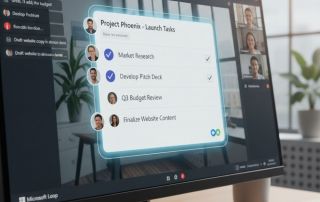
Microsoft Loop in Teams: The revolution of your notes?
What exactly are these Loop components in Microsoft Teams? We'll show you how these "living mini-documents" can accelerate your teamwork. From dynamic agendas to shared, real-time checklists – discover practical use cases for your everyday work.

Career booster 2026: These Microsoft Office skills will take you further!
A new year, new career opportunities! But which Office skills will really be in demand in 2026? "Skilled use" is no longer enough. We'll show you today's must-haves – like advanced Excel, using AI in the office, and relevant certifications for your resume.

Excel Tutorial: How to quickly and safely remove duplicates
Duplicate entries in your Excel lists? This distorts your data. Our tutorial shows you, using a practical example, how to clean up your data in seconds with the "Remove Duplicates" function – whether you want to delete identical rows or just values in a column.

Dynamic ranges in Excel: OFFSET function
The OFFSET function in Excel creates a flexible reference. Instead of fixing =SUM(B5:B7), the function finds the range itself, e.g., for the "last 3 months". Ideal for dynamic charts or dashboards that grow automatically.
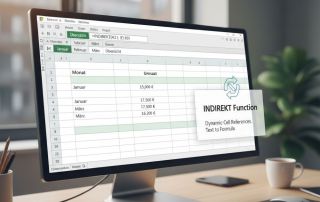
Mastering the INDIRECT function in Excel
The INDIRECT function in Excel converts text into a real reference. Instead of manually typing =January!E10, use =INDIRECT(A2 & "!E10"), where A2 contains 'January'. This allows you to easily create dynamic summaries for multiple worksheets.
Offers 2024: Word & Excel Templates